


Honorary Degree and Senior Fellowship awards
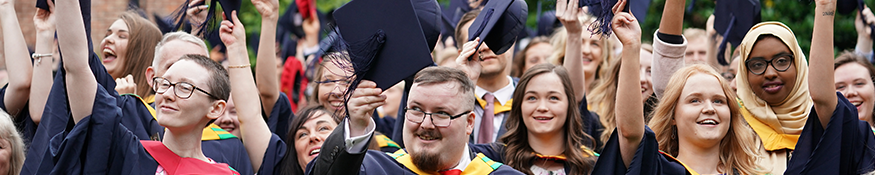
Honorary awards are among higher education's most prestigious accolades and are conferred at graduation ceremonies to recognise individuals who have made exceptional contributions to society, their profession, or the University.
At Liverpool Hope University, these awards celebrate individuals with strong regional roots or connections whose achievements align with the institutions' missions, values, and academic priorities. Recipients are recognised for making an outstanding and sustained contribution to the development of the University, achieving national or international distinction in an academic field relevant to the institution, or making a significant impact in the cultural, educational, professional, academic, or economic spheres.
Since 2006, Liverpool Hope University has also awarded Honorary Doctorates and Senior Fellowships to acknowledge individuals whose work closely reflects the University's mission, values, and aims.
Summer 2026 honorary awards
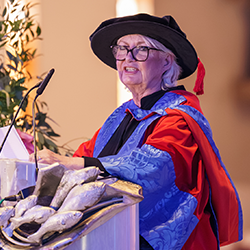 Joan Bonenfant
 Joan Bonenfant
Joan Bonenfant has been awarded a Senior Fellowship in recognition of her life-long contribution to education. From her years as a teacher, her roles in education management and leadership and her time as an OFSTED inspector she has remained committed to providing children with the best possible education.
Joan said “I am thrilled to be asked to be a Senior Fellow and humbled to have my work recognised in this way. Education is in my DNA. It had a profound impact on me when I was growing up and I want to make sure that I can do the same for other children in Liverpool.
“From the start of my career I have wanted to make a difference to people’s lives and have a clear conviction that we must provide as good an education for the children we teach as we want for our own children. This means putting what is best for them at the centre of all the decisions we make.”
In terms where education needs to change, Joan refers to the newly published report from the Education Policy Institute that shows the gap between how well pupils from better-off households perform at school, compared to classmates from lower-income households has widened.
Joan explains:
“Early years education is essential so that children do not start school disadvantaged. We need to level up at the beginning.”
Her emphasis is on understanding where the blocks are while also ensuring that expectations remain high for all learners, regardless of their background.
Joan sees reading as a cornerstone of lifelong learning. Whether fiction or non-fiction, she encourages children to explore texts that spark curiosity and help them develop independence and confidence.
“Reading is fundamental. I grew up in a less advantaged part of the city but reading gave me a golden key.
“It gives people independence and opportunities and allows them to learn throughout the whole of their lives.”
Joan’s final piece of advice is to people picking up children from school:
“I would love people to put their phones away and really engage with the children about their day. Find out what they have been learning and be part of their education.”
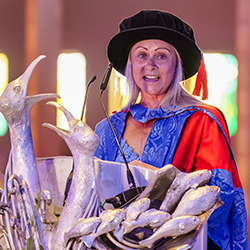 Jenny Meadows
 Jenny Meadows
Olympian Jenny Meadows awarded Honorary Doctorate by Liverpool Hope University
Jenny Meadows has been awarded an Honorary Doctorate by Liverpool Hope University in recognition of her outstanding contribution to athletics, coaching and inspiring future generations. From representing Great Britain on the world stage to helping guide Olympic champions as a coach, Jenny has dedicated her career to helping others fulfil their potential, both on and off the track.
Jenny, who graduated from Liverpool Hope with a joint honours degree in Sport, Recreation and Physical Education with English, said receiving the honour was both unexpected and deeply personal.
"I didn't know whether to cry," she said. "I was so excited. In the coaching capacity that I'm in now, everyone is always asking you for things, so for someone to come to me and for an institution that was important in my development – it was just one of those feel-good moments.
"I immediately called my husband, my mum, my brother and then my in-laws. I was just really, really proud."
Looking back on her time at Liverpool Hope, Jenny credits the University with helping her grow in confidence and develop skills that have stayed with her throughout her career.
"I really liked the campus and how intimate it is. I didn't want to go to a big city centre university, I wanted that community feel," she said.
"I had to stand on my own two feet. I had to talk to people, ask questions and find my own identity. I think I was quite shy when I first arrived, but by the end of my third year I'd really grown into being an adult.
"I definitely found my voice when I was here."
Since retiring from international competition, Jenny has become one of Britain's leading athletics coaches. Alongside her husband, Trevor Painter, she has coached athletes including Olympic champion Keeley Hodgkinson, as well as Olympic medallists Georgia Hunter Bell and Lewis Davey.
For Jenny, however, coaching is about far more than medals.
"I think it's just seeing people reach their personal potential," she said.
"Someone achieving their own personal best means so much more than somebody simply achieving the highest accolade. It's about seeing people believe in themselves."
As both a coach and a mother, Jenny is passionate about encouraging young people, particularly girls, to stay active, embrace challenges and not be afraid of making mistakes.
"I always tell my daughter it's okay to make mistakes," she said.
"Confidence, resilience and character are really important life skills. I just want girls to know it's important to be healthy and active. It doesn't have to be elite sport, as long as they're active, that's what matters."
Jenny's final message to Liverpool Hope's graduating students is one she has learned through years of competing at the highest level.
"The goalposts are always going to move," she said.
"Life isn't a straight line. There are bumps in the road, but if you accept that change is part of becoming the best version of yourself, you'll keep moving forward."
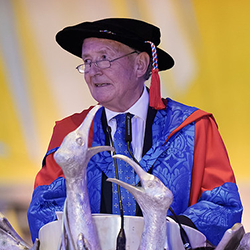 David Alton, Lord Alton of Liverpool, KCSG
 David Alton, Lord Alton of Liverpool, KCSG
Making a Difference Human Rights, Hope and Purpose.
Lord David Alton, long-standing parliamentarian and leading human rights advocate started his political life while still a student at Christ’s College, one of Hope’s founding colleges.
In 1972 he was elected as aliberal councillor to Liverpool City Council, representing a ward where half the homes had no inside sanitation, running hot water or bathrooms. Britain’s youngest councillor lost no time in getting things done and within a few years was chair of the housing committee.
Lord Alton recalls:
“I was able to get the area designated as an area for housing renewal, rather than demolition, which is what the people themselves wanted.”
Now known best as a human rights campaigner, Lord Alton is devoted to standing up for some of the world’s most vulnerable communities. He was the Chair of the Parliamentary Committee on North Korea and is Chair of the Joint Committee on Human Rights.
From campaigning against modern slavery to highlighting abuses in North Korea, Hong Kong and Iran, he said his motivation has remained constant throughout his public life.
“I have a passion for human rights. There are two sides of one coin: human rights and human dignity.”
Despite his international profile, Lord Alton stressed that meaningful change often begins with addressing individual injustices rather than grand political gestures.
Lord Alton explains:
“Life is about relationships. It isn't just about making big policy choices. It is about listening to people's stories and then trying to connect with them.
"Getting some minor injustice put right can transform people’s lives, small deeds do make a difference.”
Reflecting on his student days, he described Liverpool Hope as transformative. As the first member of his family to enter higher education, he credited the University with broadening his horizons and giving him opportunities that shaped the course of his life.
“What I got here was an extraordinary opportunity to deepen my intellectual interest, my friendships, and my faith.”
He also praised the University's enduring ethos, saying:
“The spirit is as strong as it ever was.”
A passionate advocate for education, Lord Alton spoke warmly about the vital role that teachers and universities play in helping students discover their purpose and potential.
Receiving an Honorary Doctorate from Liverpool Hope, he expressed gratitude to the tutors and mentors who supported him as a young student. He concluded with a message that continues to guide his work and which he believes lies at the heart of the University experience:
"The purpose of a university like this is to find out what our purpose is, what link are we in the chain? What difference can we make?"
 John Mohin OBE DL
 John Mohin OBE DL
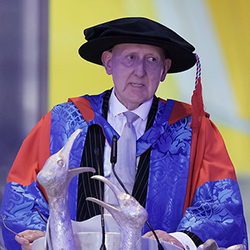
John Mohin has been awarded a Senior Fellowship by Liverpool Hope University in recognition of his distinguished career in international business and his contribution to promoting British heritage, enterprise and education around the world.
From leading one of Britain's most iconic brands, Wedgwood, to championing the value of lifelong learning, John has spent his career building relationships and inspiring future generations.
Receiving the honour, John said he was both surprised and deeply honoured.
"I am truly honoured and delighted. I've felt part of the community of this University for some time, but today I feel part of the family."
John praised Liverpool Hope for its welcoming atmosphere and strong sense of community, describing it as "a great place" with exceptional students, staff and facilities.
Reflecting on the University's identity, he also spoke about the unique opportunity presented by its connection to the city of Liverpool.
"I happen to think that Liverpool is a brand in its own right. Around the world, Liverpool is recognised. It's something very special, and I think sometimes we take that for granted."
Looking back on his own education and career, John explained how growing up in the heart of Liverpool shaped his ambitions. Rather than following the path that many around him expected, he immersed himself in books at the city's Picton Library, where he first encountered the writings of Josiah Wedgwood.
One passage, describing a vision for building a worldwide business, had a lasting impact.
"Those words resonated with me so strongly," he said. "I asked if I could join the company."
Initially turned down, John returned to business school before applying again. This time, he was successful, beginning a 35-year career with Wedgwood that would eventually see him become Managing Director and represent the company across the world.
His career took him throughout the Caribbean, Africa, Asia and the Middle East before leading the business in Japan and later across the Asia-Pacific region. He also spent eight years in Australia, where he was granted Australian citizenship.
One of the defining moments of his career came ahead of the 1994 Olympic Games.
"It was the greatest marketing opportunity in the Southern Hemisphere," he said.
"We created the first Australian Waterford Crystal collection using sand gathered from every Australian state. I got my distinguished colleague, Lord Wedgwood, to dig clay from Homebush, the site of the Olympic stadium before it was built, to create the first Wedgwood Australian collection. It generated millions for the business."
Throughout his career, John said protecting reputation and maintaining integrity were fundamental to every decision he made.
"I couldn't allow our brand to be diluted," he said. "You have to stand your ground when it comes to protecting something that people trust."
Despite decades of international experience, John believes the most important lesson he has learned is the value of remaining curious and recognising how much there is still to learn.
"As much as you know, there's so much more to know. It's a very healthy position to be in. It's called intellectual humility."
Drawing on his studies at Harvard Business School, John spoke about the importance of embracing lifelong learning and understanding that knowledge is never complete.
"Experience teaches you humility," he said. "The combination of experience and humility allows you to keep learning and applying that knowledge in productive, honest and decent ways."
For John, organisations with a rich history also have a responsibility to continue evolving.
"You might have a distinguished history, like Wedgwood or indeed Liverpool Hope, but you have to cater for future generations," he said.
"Liverpool Hope has an incredible legacy. That's something to celebrate and build upon for the future."
John's advice to Liverpool Hope's graduating students focused on one quality above all others, character. "In this world of social media and artificial intelligence, guard your reputation," he said. "Your reputation is everything. It's your character. When employers are choosing between candidates with similar qualifications, it's often your character that sets you apart. Reputation is far easier to maintain than it is to recover."
While recognising that graduates are entering an increasingly competitive jobs market, John encouraged them to remember that a degree is only part of what makes them employable. "It's your experiences, your character and how you conduct yourself that make the difference," he said. "They're the qualities that will stay with you throughout your career."
 Esther Ghey
 Esther Ghey
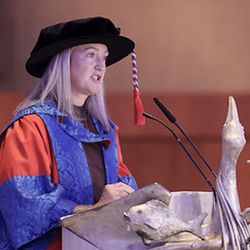
Receiving an Senior Fellowship from Liverpool Hope University was an emotional moment for Esther, who graduated from the University six years ago with a degree in Nutrition.
"It almost feels like I've come home today," she says. "I was really shocked when I found out I was receiving the award. I just felt completely honoured because I was a student here and it was one of the best times of my life."
Returning to campus brought back a flood of memories. Even after several years away, Esther found herself instinctively remembering the journey back to Hope and recognising familiar places around the campus.
"As I was walking through, it gave me such a sense of nostalgia. It makes me want to come back and study again.”
While Esther's career has taken a very different path from the one she imagined as a student, she credits her time at Liverpool Hope with giving her far more than an academic qualification.
"The confidence and skills I gained at university have been just as important as my degree. Things like public speaking, presenting and working as part of a team; you don't always realise you're learning those skills at the time, but they've been some of the most valuable things I've taken into the real world."
She also reflects on the culture of care that shaped her own experience as a student.
"The lecturers were so caring and genuinely wanted to see you achieve. I think if every area of education had that same level of compassion, it wouldn't just improve academic performance, it would have a positive impact on society as a whole."
Today, Esther's campaigning and advocacy work is helping young people and families build resilience and improve their mental wellbeing. She believes education has a vital role to play in shaping not only knowledge but confidence, empathy and purpose.
For this year's graduating students, Esther offers a reminder that success rarely follows a straight line.
"Life isn't linear. You might leave university with a plan, but life will always throw twists and turns your way. Be flexible, follow your heart and do what really means something to you. If life throws a curveball, it doesn't necessarily mean it's a bad thing. It might be different from what you expected, but something just as good can come from it."
Despite the challenges facing young people today, Esther remains hopeful about the future.
"I think young people care deeply about the world and about society. There's a real enthusiasm to make things better. While that can sometimes feel like a lot of pressure for them, I think we're going to see a generation of campaigners and activists."
Much of Esther's motivation comes from the legacy of her daughter, Brianna.
"Brianna is the main reason for everything I do. Knowing what she went through with her mental health, and knowing that so many other young people are struggling too, makes me determined to keep working for change.">
Alongside campaigning for national change, Esther also works directly with schools, delivering programmes that support children, parents and teachers. It is this work, she says, that provides some of the most rewarding moments.
"When you go into schools and see the children's faces, and see families enjoying the sessions together, you can see the impact immediately. That really warms my heart and reminds me that this is what we're meant to be doing."
She adds that sharing this work with her daughter Alisha makes it even more special.
As Esther returned to the University that helped shape her own journey, this marks not only recognition of her extraordinary contribution to improving the lives of young people, but also a fitting full-circle moment at a place she considers home.
 Dame Rachel de Souza
 Dame Rachel de Souza
Giving children a great childhood: Children’s Commissioner Dame Rachel de Souza receives an Honorary Doctorate.
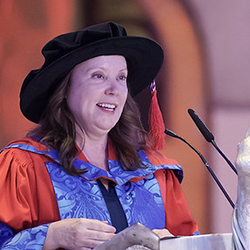
Dame Rachel de Souza, the England's Children’s Commissioner, spoke of the importance of listening to children when receiving an Honorary Doctorate from Liverpool Hope University.
Dame Rachel said the award is a particularly meaningful recognition because of her lifelong commitment to education and Liverpool Hope’s role in preparing future teachers and social workers.
“It’s such an honour. It was a real delight, especially from Liverpool Hope,” she said. “Liverpool Hope is somewhere that is creating the teachers of the future, and for me, that means such a lot. It’s like being honoured by my people.”
Drawing on years of work with children and young people across the country, including large-scale surveys and visits to schools, hospitals and prisons, she said the concerns young people raise are remarkably consistent.
“The number one thing pretty much all of them talk to me about when they’re thinking about their future is having a great job. Then money, the cost of living, friendships and more recently,war.
“They’re worried about money. We see a lot of children in poverty. They don’t worry about it for themselves. They worry about it for their friends and for their parents.”
Dame Rachel also highlighted the importance of friendship and family life, noting that young people consistently emphasise the value of strong personal relationships.
“Family life is important, whatever shape that family is,” she said. “Friendship is hugely important too.”
Reflecting on both the challenges facing children today and recent mental health data pointing to 1 million children being referred to mental health services, Dame Rachel points to the impact of social media increasing anxiety. While children are clear that they recognise the benefits of being online, she argued that greater efforts are needed to ensure they are protected from harm.
"Not one child says they want a social media ban, but they do want to use it less and want to be more protected from some of the terrible things they come across on it. So, we should stop talking about banning children and start talking about protecting children and helping them."
Despite these challenges, she remains optimistic about the next generation.
“What I see are fantastic children,” she said. “We as the adults need to think a bit more about how we can ensure children thrive.”
A former teacher and headteacher herself, Dame Rachel is clear about the importance of creating the conditions in which children can flourish.
“I think we seriously need to start focusing on childhood right across public services and across national life,” she said. “They need to be able to play, they need friendships, they need to be able to get outside, they need a great education, and they need to be with people who love them.”
Offering advice to Hope graduates about to enter the teaching profession, she described teaching as one of the most rewarding careers imaginable.
“It’s a joyous profession,” she said. “It’s an unbelievable profession. It’s the best profession.”
Encouraging future teachers to look beyond academic outcomes alone, she added: “Remember, it’s not just about outcomes. We actually need to give our children a great childhood, and you are going to be key to that.”
Dame Rachel is currently travelling the country to promote her final survey The Big Future. The Big Future survey is open to all children aged 0 to 18 in England until Friday 23rd October. Adults can respond on behalf of children. The survey is available online.